

Who Can Claim GST in India? – A Complete Guide by GST Suvidha Online
Goods and Services Tax (GST) is the most significant indirect tax reform in India, designed to bring uniformity and efficiency to the taxation system. While GST has streamlined taxation, one of the most important aspects for businesses is Input Tax Credit (ITC)—which determines who can claim GST in India and under what conditions.
At GST Suvidha Online, our mission is to simplify GST compliance for businesses, startups, and entrepreneurs across India. This article provides a detailed understanding of GST claims, eligibility, and procedures—complete with tables, graphs, and practical insights.
Understanding GST Claims in India
When businesses purchase goods or services, they often pay GST. The government allows businesses to claim back this GST if it is used for further business activities. This mechanism is called Input Tax Credit (ITC).
Simply put:
👉 GST paid on purchases (input) – GST collected on sales (output) = Net GST payable.
If input tax is more than output tax, businesses can carry forward or claim a refund.
Who Can Claim GST in India?
Not everyone can claim GST. The following categories are eligible:
|
Eligible Category |
Condition to Claim GST |
|
Registered Businesses under GST |
Must have a valid GSTIN |
|
Manufacturers, Traders, Service Providers |
GST paid must be used for business purposes |
|
Exporters |
Eligible for GST refunds under zero-rated supply |
|
Input Service Distributors (ISDs) |
Can distribute GST credit to branches |
|
E-commerce Sellers |
Can claim GST on inputs if registered |
|
Startups & SMEs |
Must cross threshold limits & be GST registered |
Graph: Share of Businesses Eligible to Claim GST in India
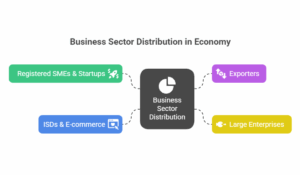
This shows the majority of GST claimants are small and medium businesses.
Conditions for Claiming GST (Input Tax Credit)
A business cannot automatically claim GST. The following conditions must be met:
|
Condition |
Explanation |
|
Must be GST Registered |
Only registered taxpayers with valid GSTIN can claim. |
|
Possession of Tax Invoice |
Original invoice from a registered supplier is mandatory. |
|
Goods/Services Received |
ITC can only be claimed after actual receipt of goods/services. |
|
GST Paid to Government |
Supplier must have deposited GST with the government. |
|
Timely Return Filing |
ITC can only be availed if returns are filed on time. |
❌ Who Cannot Claim GST in India?
- Businesses not registered under GST.
- GST paid on personal consumption.
- GST on motor vehicles (except for commercial use).
- GST on food, beverages, health insurance, and club memberships (unless mandatory for employees).
- Goods/services used for exempt supplies.
Example Case: Input Tax Credit Calculation
Suppose a business has the following:
|
Particulars |
Amount (₹) |
|
GST Paid on Purchases (Input) |
50,000 |
|
GST Collected on Sales (Output) |
70,000 |
|
Net GST Payable |
20,000 |
In this case, the business can claim ₹50,000 as ITC and only needs to pay the balance ₹20,000.
Benefits of Claiming GST
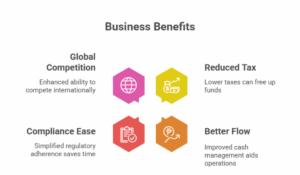
- Reduced Tax Burden – Businesses only pay net GST after adjusting ITC.
- Improved Cash Flow – Refunds or credits improve liquidity.
- Compliance Benefits – Ensures lawful tax practice.
- Global Competitiveness – Exporters can claim refunds, making Indian products competitive abroad.
Graph: Benefits of GST Claims
Step-by-Step: How to Claim GST in India
- Get GST Registered – Apply for GSTIN if turnover exceeds ₹40 lakhs (₹20 lakhs for service providers).
- Collect GST Invoices – Maintain records of all purchases and sales invoices.
- Upload Returns (GSTR-1, GSTR-3B, GSTR-9) – File monthly/quarterly/annual returns.
- Match Invoices in GST Portal – Ensure supplier has uploaded corresponding details.
- Claim ITC in GSTR-3B – Adjust ITC against output tax liability.
- Pay Remaining GST or Carry Forward – Pay balance or carry forward ITC to the next period.
GST Refunds for Exporters
Exporters and businesses engaged in zero-rated supply (exports & SEZ supplies) can claim a full refund of GST paid. This strengthens India’s global trade competitiveness.
Common Mistakes in Claiming GST
- Not verifying supplier GST compliance.
- Missing invoice details.
- Filing returns late.
- Claiming ITC on exempted/personal goods.
👉 At GST Suvidha Online, we ensure you avoid these pitfalls with expert support.
Role of GST Suvidha Online in GST Claims
At GST Suvidha Online, we simplify GST compliance through:
- Registration Services – Easy GSTIN application.
- Return Filing Assistance – Timely and error-free filing.
- Input Tax Credit Tracking – Automated reconciliation of ITC.
- Refund Processing – Helping exporters and businesses get faster refunds.
- Expert Advisory – 24×7 support for all GST queries.
Comparison Table: Manual Filing vs GST Suvidha Online
|
Aspect |
Manual Filing |
GST Suvidha Online |
|
Time Taken |
High (days) |
Low (minutes) |
|
Error Chances |
High |
Very Low (system checks) |
|
ITC Tracking |
Difficult |
Automated |
|
Refund Processing |
Delays common |
Faster with expert help |
|
Cost |
Higher (CA fees) |
Affordable |
Final Thoughts
Who can claim GST in India? The answer is simple: any GST-registered business using goods or services for business purposes. However, conditions must be met, and compliance maintained. With proper planning and expert guidance, businesses can significantly reduce tax liability and improve cash flow.
At GST Suvidha Online, we make this journey easier—helping you register, file, and claim GST seamlessly.
Call to Action
Simplify your GST compliance with GST Suvidha Online—your trusted partner for GST registration, return filing, ITC claims, and refunds.
👉 Visit us today: www.gstsuvidhaonline.com