

Who Pays Tax on a GST? | Explained by GST Suvidha Online
The Goods and Services Tax (GST) is India’s largest indirect tax reform, replacing a complex structure of excise duty, VAT, and service tax. But one question remains common among taxpayers and consumers alike:
👉 “Who pays tax on a GST?”
The answer is both simple and layered. GST is collected from consumers but paid to the government by businesses. Let’s break this down in detail.
Understanding GST: A Quick Recap
Before exploring who pays GST, let’s first understand how GST works.
- GST is a destination-based tax. This means it is ultimately borne by the final consumer of goods or services.
- Businesses act as tax collectors. They collect GST from buyers and then remit it to the government.
- GST replaces cascading taxes. Earlier, multiple layers of taxes increased costs. GST integrates them into one tax.
Who Actually Pays GST?
To clarify this, let’s see two perspectives:
|
Perspective |
Who Pays? |
|
Consumer’s View |
The consumer pays GST on every product/service they buy. Example: restaurant bill. |
|
Business’s View |
Businesses collect GST from customers and then deposit it with the government. |
So, in every GST transaction:
- Consumers bear the tax financially.
- Businesses bear the responsibility of collection, filing, and payment.
Types of GST Paid in India
|
Type of GST |
Who Pays It? |
When It Applies |
|
CGST |
Paid by consumer → Collected by seller → Govt of India |
On intra-state transactions (within a state) |
|
SGST/UTGST |
Paid by consumer → Collected by seller → State Govt |
On intra-state transactions |
|
IGST |
Paid by consumer → Collected by seller → Govt of India |
On inter-state transactions (across states) |
Example Case Study: Restaurant Bill
Imagine you eat at a restaurant and the bill is ₹1,000. GST @ 5% applies.
|
Bill Component |
Amount (₹) |
|
Food Cost |
1,000 |
|
GST (5%) |
50 |
|
Final Bill |
1,050 |
- You (consumer) pay ₹1,050.
- The restaurant keeps ₹1,000 as revenue and remits ₹50 to the government.
Thus, you pay the tax, but the restaurant files and deposits it.
Who Pays GST in Business-to-Business (B2B) Transactions?
In B2B deals, GST works through Input Tax Credit (ITC).
Example:
- A wholesaler sells goods worth ₹10,000 + 18% GST = ₹11,800 to a retailer.
- Retailer pays GST (₹1,800) but can claim ITC when selling to customers.
- Retailer sells goods to final customers at ₹15,000 + 18% GST = ₹17,700.
- Retailer collects ₹2,700 GST from consumer but adjusts it with ₹1,800 ITC.
- Retailer pays net ₹900 GST to govt.
Here, final consumer bears the tax, while businesses use ITC to avoid double taxation.
Reverse Charge Mechanism (RCM): An Exception
In most cases, suppliers collect GST.
But under Reverse Charge Mechanism (RCM), the buyer pays GST directly to the government.
Cases where RCM applies:
- Services provided by advocates, transport agencies, or government bodies.
- Import of goods and services.
|
Party |
Normal GST |
RCM GST |
|
Supplier |
Collects & pays |
Doesn’t collect |
|
Buyer |
Just pays price |
Pays price + GST to Govt |
GST and Different Taxpayers
Let’s identify who pays GST in different categories:
|
Category |
How They Pay GST |
|
Consumers |
Pay GST as part of final price. |
|
Businesses (SMEs) |
Collect GST from customers and remit after claiming ITC. |
|
Exporters |
Zero-rated – do not pay GST but claim refund of input taxes. |
|
Importers |
Pay IGST on imports under RCM. |
|
Government bodies |
Pay GST when procuring taxable goods/services. |
Graph: Distribution of GST Burden
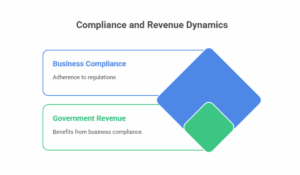
This graph shows tax cost falls on consumers, compliance on businesses, benefit on government.
Why This System Works
- Fairness: Tax is borne by the end consumer of goods/services.
- Transparency: Clear invoice system shows GST separately.
- No Cascading: ITC prevents tax-on-tax.
- Ease of Collection: Government collects from fewer businesses rather than millions of consumers directly.
Key FAQs on “Who Pays Tax on a GST?”
Q1: Do consumers directly pay GST to the government?
No. They pay GST to businesses while buying goods/services. Businesses transfer it to govt.
Q2: Do businesses bear any GST cost?
Generally no, since they claim ITC. However, if ITC is not available, businesses may bear partial GST.
Q3: Who pays GST on imports?
Importers pay GST under Reverse Charge and then claim ITC if eligible.
Q4: Who pays GST in exports?
Exports are zero-rated. Exporters don’t pay GST but claim ITC refund.
Conclusion
So, who pays tax on a GST?
- Consumers: Pay GST in product/service price.
- Businesses: Act as intermediaries—collect, file, and remit.
- Government: Receives GST revenue to fund public welfare.
In short, the consumer pays, businesses manage, and the government benefits.
Call to Action
Simplify your GST compliance journey with GST Suvidha Online. Whether you are a business owner or individual, we make GST filing, registration, and advisory effortless.
👉 Start today with us at www.gstsuvidhaonline.com
Let GST Suvidha Online be your partner in smart compliance.