
What is the GST Rate in India? – A Complete Guide by GST Suvidha Online
Goods and Services Tax (GST) has been one of the most significant tax reforms in India’s history. Introduced on 1st July 2017, GST replaced multiple indirect taxes like VAT, Service Tax, and Excise Duty with a single unified tax system.
But the question that confuses most taxpayers is:
👉 “What is the GST rate in India?”
At GST Suvidha Online, we simplify this question by breaking down GST rates into slabs, categories, and their real-world impact.
Understanding GST Rate Structure in India
GST in India is structured into five main slabs, designed to balance revenue needs and affordability for consumers.
| GST Slab | Rate | Examples of Goods/Services |
| 0% | Exempt | Fresh vegetables, milk, education, healthcare |
| 5% | Low Rate | Essentials like packaged food, footwear (<₹1000), cab rides |
| 12% | Standard | Computers, processed food, mobile phones |
| 18% | Standard | Electronics, restaurants (non-AC), financial services |
| 28% | Luxury | Cars, ACs, cigarettes, luxury goods |
Graph: Distribution of Items Across GST Slabs
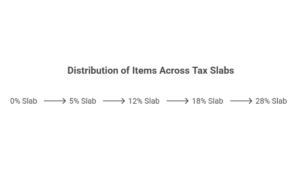
👉 The majority of goods and services fall under the 18% slab, while essentials are either exempt or taxed at 5%.
Why Multiple GST Rates?
The Indian economy is diverse—covering basic necessities to luxury products. To ensure fairness:
- Essentials (0%–5%) → Keep costs low for the poor and middle class.
- Standard Goods (12%–18%) → Moderate tax for mass consumption.
- Luxury/Demerit Goods (28%) → Higher tax to discourage non-essential use and boost revenue.
This progressive tax model ensures inclusivity and reduces burden on low-income households.
Key GST Rates for Common Goods & Services
Here’s a more detailed breakdown:
| Category | GST Rate |
| Fresh fruits & vegetables | 0% |
| Milk, bread, eggs | 0% |
| Railways/Metro tickets | 5% |
| Packaged food | 5% |
| Smartphones | 12% |
| Business-class air travel | 12% |
| Furniture, home appliances | 18% |
| Insurance, banking services | 18% |
| Five-star hotels | 28% |
| Luxury cars, tobacco | 28% + Cess |
Cess on Top of GST (for Sin Goods)
In addition to the 28% slab, certain sin goods like cigarettes, aerated drinks, and luxury cars attract an additional compensation cess.
Example:
- Luxury Car → 28% GST + 15% Cess = 43% effective tax.
- Cigarettes → 28% GST + 290% Cess (based on length).
Graph: Effective Tax Burden on Luxury vs Essential Goods
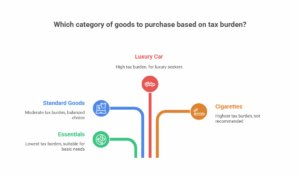
👉 The government uses GST to support affordability of essentials while taxing luxury/sin items heavily.
Impact of GST Rates on Businesses
1. SMEs and Startups
- Lower compliance burden compared to multiple old taxes.
- But, working capital challenges due to 18% slab on many services.
2. Consumers
- Transparent tax (visible on bills).
- Essentials cheaper due to 0% and 5% slabs.
3. Government Revenue
- Ensures a steady flow of indirect taxes.
- Higher taxes from luxury goods balance subsidies on essentials.
How GST Suvidha Online Helps You Navigate Rates
At GST Suvidha Online, we simplify compliance by:
- Rate Classification Support → Identify correct GST rate for your product/service.
- Auto Tax Calculation → Invoices prepared with accurate GST slab.
- Return Filing → GSTR-1, 3B, 9 filing with correct rate mapping.
- Business Advisory → Plan pricing and costing in line with GST rates.
Future of GST Rates in India
Experts suggest India might move towards a 3-slab structure (0%, 8%, and 18%) in the future for simplicity. This would:
- Reduce confusion.
- Minimize classification disputes.
- Balance revenue with affordability.
FAQs on GST Rates in India
Q1. What is the current highest GST rate in India?
👉 28%, applicable on luxury and sin goods (with cess for some).
Q2. Are all food items exempt from GST?
👉 No. Fresh food is exempt, but processed/packaged items usually attract 5% or 12%.
Q3. What GST rate applies to services?
👉 Most services fall under 18%, with exceptions (transport at 5%, hotels at 12–28%).
Q4. Is GST the same across all states?
👉 Yes, GST is uniform nationwide, unlike VAT which varied across states.
Final Thoughts
So, what is the GST rate in India?
It depends on the nature of goods/services:
- 0%–5% for essentials
- 12%–18% for standard items
- 28% + Cess for luxury/sin goods
GST has streamlined taxation across India, bringing transparency and fairness. For businesses, understanding the right slab is crucial to compliance.
Call to Action
Stay compliant, avoid penalties, and simplify your GST filings with GST Suvidha Online—your trusted partner in GST compliance.
👉 Visit now: www.gstsuvidhaonline.com