
What is the GST Tax in India?
India introduced the Goods and Services Tax (GST) on 1st July 2017 as the most significant tax reform in the country’s history. The aim was simple: “One Nation, One Tax”. GST replaced a complex web of indirect taxes like VAT, excise duty, service tax, and others with a single unified tax structure. At GST Suvidha Online, we help businesses, startups, and individuals understand, register, and comply with GST in the most efficient way possible. Let’s explore in detail what GST is, how it works, its benefits, and why it matters to you.Definition of GST
GST (Goods and Services Tax) is an indirect tax levied on the supply of goods and services across India. It is a destination-based tax, meaning GST is collected at the place where goods/services are consumed, not where they are produced.Objectives of GST
- To eliminate the cascading effect of multiple taxes.
- To unify India under one common market.
- To improve tax compliance through digitization.
- To ensure transparency in tax collection.
- To reduce tax evasion and broaden the tax base.
Structure of GST in India
GST is divided into three main categories:| Type of GST | Levy By | Applicable On |
| CGST (Central GST) | Central Government | Intra-state sales |
| SGST (State GST) | State Government | Intra-state sales |
| IGST (Integrated GST) | Central Government | Inter-state sales & imports |
- CGST = 9% (₹9,000)
- SGST = 9% (₹9,000)
- IGST = 18% (₹18,000)
Graph: GST vs Old Tax System
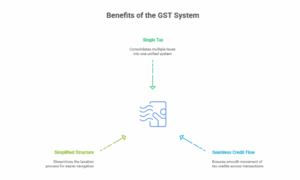 Graph Insight: GST removed multiple layers of taxes, replacing them with one streamlined system.
GST Tax Rates in India
GST rates are divided into slabs depending on the type of goods or services.| GST Slab | Applicable Items |
| 0% | Fresh fruits, vegetables, milk, bread |
| 5% | Railways, cab rides, packaged food, medicines |
| 12% | Mobile phones, processed food, computers |
| 18% | Restaurants (AC), services, cosmetics, industrial goods |
| 28% | Luxury cars, tobacco, aerated drinks |
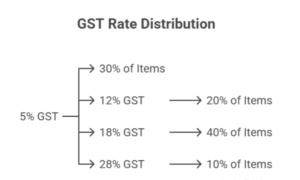
Pie Chart: Distribution of GST Rate Slabs
Benefits of GST
For Businesses:
- Input Tax Credit (ITC) reduces overall tax liability.
- Simple digital filing via GSTN portal.
- Unified compliance across India.
For Consumers:
- Transparent pricing (tax is clearly shown on bills).
- No hidden taxes.
- Cheaper logistics, leading to reduced prices.
For Government:
- Improved tax collection.
- Widened taxpayer base.
- Reduced tax evasion.
Challenges of GST
While GST has been revolutionary, businesses also face challenges:- Frequent updates in GST law.
- Technical glitches on GSTN portal.
- Working capital blockage due to late refunds.
GST Revenue Growth in India
| Year | Average Monthly GST Collection (₹ Crore) |
| 2017-18 | 89,000 |
| 2018-19 | 97,000 |
| 2019-20 | 1,02,000 |
| 2020-21 | 95,000 (COVID impact) |
| 2021-22 | 1,23,000 |
| 2022-23 | 1,49,000 |
| 2023-24 | 1,67,000+ |
Who Should Register for GST?
As per law, the following businesses must register under GST:- Businesses with turnover above ₹40 lakh (₹20 lakh for NE & hill states).
- Inter-state suppliers.
- E-commerce operators.
- Service providers with turnover above ₹20 lakh.
- Voluntary registration for startups to avail Input Tax Credit.
Role of GST Suvidha Online
At GST Suvidha Online, we bridge the gap between taxpayers and GSTN with services like:- GST Registration & Migration.
- Return Filing (monthly, quarterly, annual).
- E-Way Bill Generation.
- ITC Reconciliation & Audit Support.
- Training and Compliance Advisory.